Security briefings you can actually keep.

103 free briefings on cybersecurity, IT risk and compliance. Every topic ships as a detailed infographic and a PDF field reference you can download, print and share. No sign-up.

10 categories, 103 topics.

AI Security and Governance

Governing AI risk, securing LLM applications and reining in shadow AI.

4 topics

AI Security and Governance

AI Governance and Risk Management

Every AI model an organization builds, buys, or embeds — from vetted platforms to shadow tools employees adopt on their own — carries risk traditional software review was never built to catch. Governance turns unmanaged AI use into an accountable program.
AI Security and Governance

LLM and AI Application Security

Connecting a model to tools and data turns its output into action — guardrails contain what a manipulated model can actually do, since the model itself cannot reliably tell trusted instructions from attacker input.

AI Security and Governance

Shadow AI and BYO-AI Risk

The same AI vendor's free and enterprise tiers can carry entirely different data training and retention terms. The risk isn't whether an AI tool is reputable — it's which agreement is actually in place when an employee pastes sensitive data into it.

AI Security and Governance

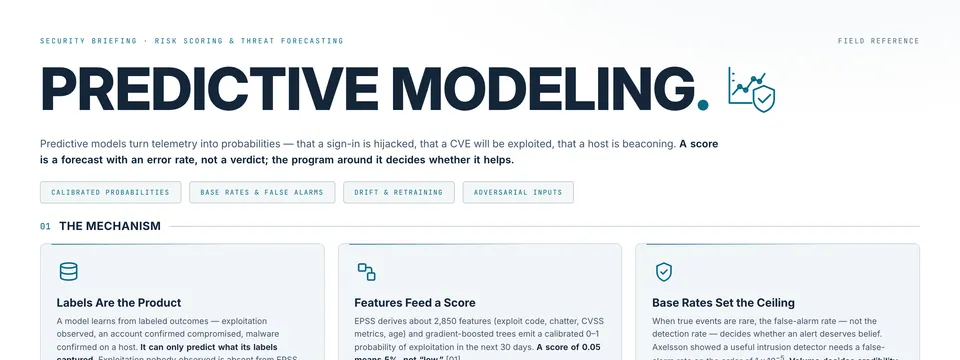
Predictive Modeling

Predictive models turn telemetry into probabilities — that a sign-in is hijacked, that a CVE will be exploited, that a host is beaconing. A score is a forecast with an error rate, not a verdict; the program around it decides whether it helps.

Application and Software Security

AppSec, API security, DevSecOps pipelines and the software supply chain.

8 topics

Application and Software Security Original edition

Software Supply Chain Security

Modern software is assembled, not written from scratch — most of a codebase is open-source dependencies nobody on the team wrote. Supply chain security tracks what's actually inside that assembly and locks down the pipeline that builds and ships it.

Application and Software Security

Application Security (AppSec)

Vulnerabilities are cheapest to fix before code ships — AppSec builds security checks directly into the development pipeline, catching flaws in code, dependencies, and configuration before they reach production.

Application and Software Security

API Security

Every API is a direct line into application logic and data — unauthenticated, unmonitored, or undocumented endpoints turn that convenience into an open door for attackers to walk through.

Application and Software Security

DevSecOps and CI/CD Pipeline Security

Shipping fast and shipping secure aren't in conflict — the fastest pipelines catch vulnerabilities before they reach a build artifact, not after a production incident.

Application and Software Security

API Rate Limiting and Bot Abuse

A botnet defeats a per-IP rate limit just by spreading out — the real control isn't how many requests come from one address, it's whether the traffic behaves like the automation it actually is.

Application and Software Security

GraphQL Security

A single GraphQL request can nest, alias, and multiply its way to the computational cost of thousands — the danger isn't how many requests arrive, it's how much any one of them is actually allowed to ask for.

Application and Software Security

Webhook and Event-Driven API Security

A webhook flips the usual direction of trust — the receiver has to authenticate a push it never asked for, and the sender has to make sure that push can't be pointed anywhere it shouldn't reach.

Application and Software Security Later edition

Software Supply Chain Security

Most of what ships in modern software was never directly chosen by anyone who built it — the supply chain attack surface lives in the dependencies of dependencies, and in the build pipeline that assembles them, not just the code a team actually wrote.

Banking, Payments and Financial Regulation

PCI DSS, SWIFT CSP, DORA, NYDFS and the payment rails and core systems behind them.
19 topics

Banking, Payments and Financial Regulation

PCI DSS and Payment Card Security

PCI DSS governs any system that stores, processes, or transmits cardholder data — compliance is a continuous state validated at a point in time, not a permanent guarantee, and a poorly scoped assessment can miss most of the real environment.
Banking, Payments and Financial Regulation

SWIFT Customer Security Programme

SWIFT's own network has never been the point of failure in a major payment fraud incident — the customer's local messaging environment consistently is, which is exactly the gap the Customer Security Programme exists to close.

Banking, Payments and Financial Regulation

FFIEC and GLBA Safeguards Rule

GLBA requires every financial institution to safeguard customer data: banks under the Interagency Guidelines that FFIEC-handbook examiners assess, non-banks under the FTC's Safeguards Rule. A policy document that was never operationalized satisfies neither.

Banking, Payments and Financial Regulation

Wire and ACH Transfer Fraud

Almost every successful wire or ACH fraud hinges on one moment: a payment instruction change that looks legitimate enough to act on without independent verification. Once a transfer executes, it's effectively irrevocable — the control has to work before the money moves, not after.

Banking, Payments and Financial Regulation

Real-Time Payments Security

FedNow and the RTP network settle payments in seconds, 24/7/365 — with no ACH-style clearing window or staffed wire review to give fraud interdiction a chance. Once a real-time payment is authorized, prevention has already happened or it hasn't happened at all.

Banking, Payments and Financial Regulation

AML and Transaction Monitoring Security

Transaction monitoring watches ongoing flows for patterns — structuring, layering, unusual velocity — that a single-transaction fraud control was never built to see. But the monitoring system is itself infrastructure, and a rule an insider can quietly disable is a control that was never really there.

Banking, Payments and Financial Regulation

Core Banking Systems Security

Every mobile app, ATM, and card swipe ultimately reads from and writes to a core banking system that, at much of the industry, still runs on decades-old COBOL and mainframe technology. Modern APIs increasingly wrap that core, but wrapping it isn't replacing it — the legacy platform's risk profile doesn't disappear.

Banking, Payments and Financial Regulation

ATM and POS Terminal Security

ATMs and POS terminals are the physical hardware where card-present fraud actually happens — skimmers on the card slot, cameras over the keypad, malware on the machine itself. EMV chip cryptography stops cloning, but it doesn't stop a device attacker from capturing data or an ATM from being commanded to dispense cash directly.

Banking, Payments and Financial Regulation

Card Network Tokenization

A network token looks like a real card number to existing payment infrastructure, but it maps back to the actual PAN only inside the card network's own vault. Domain restriction and a fresh cryptogram for each cardholder-initiated payment are what make a stolen token nearly worthless outside the exact context it was issued for.

Banking, Payments and Financial Regulation

Open Banking and API Security

PSD2 requires banks to open account data and payment initiation to licensed third parties, usually through dedicated APIs, with the customer's explicit consent. The security model shifts from a closed system to a verified, scoped, and cryptographically authenticated one — not an open door.

Banking, Payments and Financial Regulation

Payment Gateway and Processor Security

A single card payment passes through a gateway, a processor, an acquiring bank, the card network, and an issuing bank before it's actually approved. Each hop is a distinct system with its own security responsibilities, and authorization is only the first of three separate events before money actually moves.

Banking, Payments and Financial Regulation

Digital Wallet and Mobile Payment Security

Mobile wallets keep payment credentials in a dedicated secure chip, isolated from the general operating system, or limit them to short-lived cloud tokens so little is ever stored on the device. A provisioned token still isn't enough to pay; most payments also require a biometric, passcode, or recent device unlock.

Banking, Payments and Financial Regulation

Central Bank Digital Currency (CBDC) Security

A central bank digital currency turns monetary issuance into a distributed technical system — the security question shifts from protecting data to protecting the integrity of money itself, where a single compromised key can mean unauthorized currency, not just a leak.

Banking, Payments and Financial Regulation

EU DORA (Digital Operational Resilience Act)

DORA turns ICT risk into a board-owned, directly-regulated discipline across the EU financial sector — and for the first time gives supervisors direct reach into the technology vendors, like cloud providers, that financial institutions depend on.

Banking, Payments and Financial Regulation

NYDFS Cybersecurity Regulation (23 NYCRR 500)

New York's cybersecurity rule ties compliance directly to a named executive's signature — the CISO and highest-ranking officer personally certify the program each year, turning a paperwork exercise into individual accountability.

Banking, Payments and Financial Regulation

NAIC Insurance Data Security Model Law

The NAIC Model Law only becomes real once a state enacts it — a licensee's actual obligations are set by a patchwork of individual state statutes, not a single uniform national rule.

Banking, Payments and Financial Regulation

Basel Committee Operational Resilience and Cyber Risk Principles

Basel's principles measure success by whether a critical operation keeps running through disruption, not by whether disruption was prevented — and the principles themselves carry no legal force until a national regulator writes them into binding rules.

Banking, Payments and Financial Regulation

SEC Cybersecurity Disclosure Rule (2023)

The SEC doesn't mandate how a company secures its systems — it mandates that investors find out, within four business days of a materiality call, when something material happens.

Banking, Payments and Financial Regulation

OCC Super Intelligence Supervisory Framework

On November 4, 2026 the OCC gave its examiners a sixteen-component framework for reviewing how banks use Super Intelligence, the federal government’s new name for AI. It is an examiner resource, not a rule: control intensity follows what an SI system could do if it fails, not how sophisticated the model is.

Cloud and Container Security

CSPM, CASB, SSPM, CIEM and the Kubernetes layer underneath.

6 topics

Cloud and Container Security

Cloud Security Posture Management (CSPM)

Cloud environments change by the hour — new resources, new permissions, new exposure. CSPM continuously scans configurations against security baselines, catching the misconfigurations and posture drift that firewalls and endpoint tools were never built to see.

Cloud and Container Security Original edition

Container and Kubernetes Security

Containers ship in minutes and multiply across clusters just as fast — a single vulnerable image or misconfigured pod can spread the exposure everywhere it's deployed before anyone notices.

Cloud and Container Security

Cloud Access Security Broker (CASB)

Data now moves through dozens of cloud apps IT never approved — a broker sits at that chokepoint to see, control, and secure traffic that firewalls and endpoint agents never touch.

Cloud and Container Security

SaaS Security Posture Management (SSPM)

Every SaaS app is its own security perimeter with its own settings — SSPM continuously checks that perimeter against a baseline, instead of trusting that whoever configured it got it right once.

Cloud and Container Security

Cloud Infrastructure Entitlement Management (CIEM)

Cloud IAM roles and service accounts are almost always granted far more access than they ever actually use. That gap between granted and used permissions is exactly what defines a compromised identity's blast radius — and it's invisible to tools that only check resource configuration.

Cloud and Container Security Later edition

Container and Kubernetes Security

Kubernetes ships permissive by default, not secure by default — flat pod networking, unrestricted pod security, and unencrypted secrets are the starting point, not a misconfiguration someone introduced later.

Cryptography and Encryption

Key management, TLS and the move to post-quantum cryptography.

5 topics

Cryptography and Encryption

Post-Quantum Cryptography

Cryptographic algorithms designed to resist attacks from a cryptographically relevant quantum computer. RSA and ECC remain safe today, but harvest-now-decrypt-later capture means the migration has to start before that computer ever exists.

Cryptography and Encryption

Encryption and Key Management

The algorithm is the easy part — the real risk lives in how keys are generated, stored, rotated, and destroyed across their entire working lifecycle.

Cryptography and Encryption

Data Encryption in Transit and TLS

Data crossing a network is only as safe as the channel encrypting it — TLS proves the connection is authentic and unreadable before a single application byte moves.

Cryptography and Encryption

Quantum Key Distribution

Quantum key distribution uses the physics of single photons, not computational difficulty, to exchange encryption keys — any attempt to intercept the key measurably disturbs it, but everything else in the network still depends on ordinary security discipline.

Cryptography and Encryption

Post-Quantum Cryptography Migration

A quantum computer capable of breaking today's public-key cryptography doesn't exist yet — but adversaries are already harvesting encrypted traffic to decrypt the moment one does, which is why migration has to start now.

Governance, Risk and Privacy

NIST CSF, ISO 27001, SOC reports, CMMC, third-party risk and privacy law.

15 topics

Governance, Risk and Privacy

Data Governance

The framework of policies, roles, and controls that decide who can access data, how it's classified, and how long it's kept. Without governance, a strong security stack still can't answer whether this data should exist.

Governance, Risk and Privacy

Third-Party Risk Management

The discipline of vetting, tiering, contracting, and continuously monitoring every vendor, supplier, and partner that touches your data or systems. A signed contract proves obligation — it never proves compliance.

Governance, Risk and Privacy

Fourth and Nth-Party Risk

The risk introduced by your vendors' own vendors — and everything downstream of them. Your direct vendor may be secure; the subprocessor two tiers down that you've never heard of is where the actual exposure lives.
Governance, Risk and Privacy

Security Metrics, KPIs and Board Reporting

A board doesn't need every alert — it needs to know whether risk is going up or down and what it will cost to change that, translated out of security jargon and into business terms.

Governance, Risk and Privacy

GDPR and Global Privacy Regulation

GDPR covers any organization established in the EU, plus firms anywhere that offer goods or services to, or monitor, people in the EU. Consent is only one of six lawful bases, and defaulting to it for everything often creates more compliance risk, not less.

Governance, Risk and Privacy

NIST Cybersecurity Framework 2.0

NIST published Cybersecurity Framework 2.0 on February 26, 2024, its first major update since 2014. It is a taxonomy of high-level cybersecurity outcomes for any organization, not a control set, a checklist or a certification: CSF 2.0 says what good looks like and leaves the how to the standards it maps to.

Governance, Risk and Privacy

ISO 27001 and 27002

ISO/IEC 27001:2022 is the requirements standard for an information security management system; ISO/IEC 27002:2022 is the guidance that explains its 93 reference controls. One is audited and certified, the other is read and applied: certification is to 27001 alone, and 27002 cannot be certified to.

Governance, Risk and Privacy

COBIT 2019

ISACA’s COBIT 2019 is a framework for the enterprise governance of information and technology: 40 governance and management objectives, seven components and eleven design factors for a governance system that fits the enterprise. It splits what the board governs from what management runs, and it is designed, not adopted.

Governance, Risk and Privacy

CIS Controls v8.1

The Center for Internet Security’s Critical Security Controls v8.1, released June 2024, are a prioritized, prescriptive set of 18 Controls and 153 Safeguards built from attack data. Three Implementation Groups set the order of work: every enterprise starts with the 56 Safeguards of IG1, essential cyber hygiene.

Governance, Risk and Privacy

NIST SP 800-53 and the RMF

NIST SP 800-53 Rev. 5 is a catalog of 1,014 active security and privacy controls and enhancements in 20 families. SP 800-53B picks a baseline by FIPS 199 impact level, SP 800-53A says how to assess, and the SP 800-37 RMF turns them into an authorization decision: the catalog supplies the controls; the RMF supplies the decision.

Governance, Risk and Privacy

SOC 2 Trust Services Criteria

A SOC 2 report is a CPA’s attestation under AICPA standards, not a certification. Management draws the system boundary, picks the trust services categories and writes the description; the auditor opines on it against the 2017 Trust Services Criteria. You define the system; the auditor tests what you claimed about it.

Governance, Risk and Privacy

CMMC 2.0 and NIST SP 800-171

DFARS has required defense contractors to protect CUI with NIST SP 800-171 since 2017; CMMC adds the proof. The 32 CFR Part 170 program rule took effect December 16, 2024 and the DFARS clause followed on November 10, 2025: whether the data is FCI or CUI sets the level, and the level sets who must verify it.

Governance, Risk and Privacy

SOC 1 Reports and ICFR

A SOC 1 is a CPA’s examination under AT-C section 320 of controls at a service organization likely to be relevant to user entities’ internal control over financial reporting. Written for those customers and their auditors, it asks whether a vendor could misstate your books, not whether it is secure.

Governance, Risk and Privacy

SOC 3 General Use Reports

A SOC 3 is the general-use report from an AICPA examination of a service organization’s controls against the trust services criteria. It carries the CPA’s opinion on operating effectiveness over a period but none of the tests or results. Same criteria and control opinion as a SOC 2 type 2, without the detail.

Governance, Risk and Privacy

SOC for Cybersecurity

SOC for Cybersecurity is the AICPA’s entity-wide attestation, introduced in April 2017. Management describes its whole cybersecurity risk management program against the description criteria, asserts that controls met its objectives, and a CPA opines on both. One opinion on the whole program, built to be shared.

Identity and Access Security

IAM, PAM, passkeys, secrets, machine identities and Active Directory hardening.

16 topics

Identity and Access Security

Passkeys

Phishing-resistant authentication built on public-key cryptography. The private key never reaches the server, syncs only end-to-end encrypted, and cannot be replayed by an attacker who captures the traffic.

Identity and Access Security

Identity and Access Management (IAM)

Every account, role, and permission an organization grants is a potential path in — and the accounts nobody remembers to review are the ones attackers find first. IAM turns identity from a one-time provisioning task into a continuously governed control.

Identity and Access Security

Privileged Access Management (PAM)

Every admin credential, service account, and root password is a high-value target — and standing privileged access is often the shortest path from one compromised login to full domain control. PAM replaces persistent admin rights with vaulted, time-bound, monitored elevation.

Identity and Access Security

Password Managers and Browser-Saved Risk

A password saved in the browser is only as safe as the device it lives on — a password manager decides whether that credential survives when the device doesn't.

Identity and Access Security Original edition

Secrets Management and Credential Sprawl

An API key hardcoded once doesn't expire when the project ends — it stays valid in code, logs, and forgotten scripts until someone finds it, or someone else does.

Identity and Access Security

Non-Human Identity and Machine-to-Machine Auth

Every API key, service account, and workload identity is a credential nobody logs into — non-human identity governance treats machine credentials with the same rigor as human ones, because attackers already do.

Identity and Access Security

Identity Threat Detection and Response (ITDR)

Attackers increasingly log in rather than break in, authenticating with stolen valid credentials and tokens that never touch a monitored endpoint. ITDR watches the identity infrastructure itself for the specific patterns credential theft produces, since nothing else is built to catch it.

Identity and Access Security

OAuth 2.0 and OpenID Connect Security

OAuth 2.0 was built to authorize, not to authenticate — treating a successful token exchange as proof of identity, instead of validating OpenID Connect's purpose-built ID token, is the mistake underneath most real-world OAuth failures.

Identity and Access Security Later edition

Secrets Management and Credential Sprawl

A secret doesn't stay secret because it's hard to find — it stays secret because someone is actively managing where it lives, how long it's valid, and when it gets rotated, none of which happens by default.

Identity and Access Security

Active Directory and Kerberos Security

Active Directory holds domain identities; Kerberos turns authentication into reusable tickets. Protect the accounts, hosts, and keys behind that trust: a valid ticket is not proof of a safe session.

Identity and Access Security

Active Directory Certificate Services (AD CS) Security

Active Directory Certificate Services issues credentials for users, devices, and services. Protect who can obtain a certificate, which identity it represents, and where its private key can be used.

Identity and Access Security

NTLM Relay and Authentication Hardening

NTLM relay forwards a live authentication exchange to a service that accepts it as the victim. The attacker need not know the password: reduce NTLM use and enforce protection at every receiving service.

Identity and Access Security

Break-Glass Accounts and Emergency Access

Break-glass accounts restore administrative access when normal sign-in, federation, or privilege activation fails. A recovery path must survive the failed dependency, protect its credentials, and leave evidence of every use.

Identity and Access Security

Windows LAPS

Windows LAPS gives every device its own local administrator password, rotates it on a schedule, and backs it up to Active Directory or Microsoft Entra ID where only authorized roles can read it. It exists because one shared local admin password turns a single compromised machine into all of them.

Identity and Access Security

Active Directory Delegation Security

Delegation is how Active Directory hands power to someone else: rights over objects through access control lists, and the ability to act as a user through Kerberos. Both live in attributes rather than group memberships, and attackers hunt them because few teams review them.

Identity and Access Security

Group Policy Security

A Group Policy Object is configuration that runs as SYSTEM on every computer it reaches and as the user at every sign-in; whoever can edit or link one holds that power. Securing Group Policy means deciding who may write to its two stores, what may link where, and never leaving a secret in SYSVOL.

Network and Infrastructure Security

Zero trust, segmentation, DNS, VPN exposure, OT/ICS and telecom networks.

8 topics

Network and Infrastructure Security Original edition

Zero Trust Architecture

A security model where no user, device, or network flow is trusted by default — inside the perimeter or outside it. Each session is verified and authorized before access is granted, then re-evaluated continuously.

Network and Infrastructure Security

VPN Security and Exposure

VPN gateways are internet-facing, always-on, and rarely patched on schedule — making them one of the most exploited entry points into corporate networks. From split-tunneling misconfigurations to unpatched appliance CVEs, a poorly governed VPN becomes the front door attackers actually use.

Network and Infrastructure Security

Network Segmentation and Microsegmentation

A flat network lets one compromised device reach everything else — microsegmentation contains the blast radius so a breach cannot spread into the next zone.

Network and Infrastructure Security

DNS Security

Every connection starts with a name lookup — DNS security makes sure that lookup can't be silently redirected, poisoned, or turned into a covert exfiltration channel.

Network and Infrastructure Security

OT and ICS Security

Operational technology runs the physical world — valves, turbines, breakers, pumps — so a compromise isn't just a data-loss event. Safety and availability outrank confidentiality here, and the controls that work in IT can crash the equipment they're meant to protect.

Network and Infrastructure Security

5G and Telecom Network Security

5G's shared, software-defined core turns network slicing and inter-carrier signaling into the new attack surface — isolation between slices and trust between carriers must be continuously verified, not just assumed by design.

Network and Infrastructure Security Later edition

Zero Trust Architecture

Zero trust replaces a single perimeter check with continuous verification of every request — network location stops implying trust, and identity, device posture, and policy decide access instead.

Network and Infrastructure Security

Network and Domain Lookups

Five lookups answer almost every question about a name or an address: who is accountable for it, what it resolves to, whether packets reach it, what it presents when they do, and how it is configured. Each one proves something narrow, and the usual mistake is reading more into it than it says.

Threat Detection and Incident Response

SIEM, EDR/XDR, threat intelligence, ransomware, forensics and recovery.

13 topics

Threat Detection and Incident Response

Ransomware

Malware that encrypts data and holds it hostage for payment. Modern campaigns steal data before they encrypt it — turning a single intrusion into extortion, business disruption, and reputational damage.

Threat Detection and Incident Response

Vulnerability Management

The continuous process of finding, prioritizing, and closing weaknesses before adversaries can use them. A CVSS score alone doesn't tell you what to fix first — exploitability and business context do.

Threat Detection and Incident Response

Attack Surface Management

Every internet-facing asset an organization exposes — domains, subdomains, cloud services, and forgotten infrastructure — mapped continuously, not once a year. You cannot secure what you do not know you own.

Threat Detection and Incident Response

Incident Response and Tabletop Exercises

A breach is not primarily a technology event — it's a decision-making event under pressure. Incident response turns a chaotic first hour into a rehearsed playbook, and tabletop exercises make sure that playbook actually works before it's needed for real.

Threat Detection and Incident Response

Business Continuity and Disaster Recovery

Outages, disasters, and attacks are a matter of when, not if — the difference is how fast the organization gets back up. Business continuity keeps critical operations running through disruption, and disaster recovery restores the systems behind them within a defined, tested window.

Threat Detection and Incident Response

Endpoint Detection and Response (EDR-XDR)

Antivirus asks whether a file matches a known bad signature — EDR and XDR ask whether behavior looks malicious. They watch what processes actually do on the endpoint, then correlate that activity across identity, email, and cloud to catch what static signatures miss.

Threat Detection and Incident Response

Security Operations and SIEM

Attack signals don't announce themselves — they hide inside millions of logs across endpoints, network, and cloud every day. SIEM correlates that noise into the alerts analysts can actually act on.

Threat Detection and Incident Response

Penetration Testing and Red Teaming

Vulnerability scans tell you what's wrong — a red team tells you what an attacker can actually do with it, chained together toward a real objective.

Threat Detection and Incident Response

Threat Intelligence and Threat Hunting

An IOC feed without context tells you what happened somewhere else — it does not tell you what is already inside your own environment, right now.

Threat Detection and Incident Response

SOAR and Security Automation

SOAR connects detection tools to automated response actions through codified playbooks — it makes a well-understood response faster and more consistent, but a playbook only automates the judgment that was already built into it.

Threat Detection and Incident Response

Digital Forensics and Incident Response

DFIR reconstructs what actually happened on a compromised system from the artifacts it left behind — evidence that isn't captured before it's overwritten or powered away is gone permanently, no matter how skilled the analyst.

Threat Detection and Incident Response

Endpoint Detection and Response (EDR and XDR)

A signature can only catch what's already been seen before — modern detection has to watch what a process actually does, and increasingly, whether the detection agent itself is still alive to watch it.

Threat Detection and Incident Response

Asset Risk Scoring

An asset risk score ranks what to fix first by combining what the asset is worth, how exposed it is, and how likely a threat is to reach it. The arithmetic is easy; the inventory, the criticality labels and the exposure facts behind it are the hard part.

Workforce, Endpoint and Data Protection

Phishing, BEC, insider threat, DLP, mobile devices and email authentication.

9 topics

Workforce, Endpoint and Data Protection

Insider Threat Management

The riskiest actor in your environment might already have valid credentials, legitimate access, and no reason to raise an alarm — because they're an employee, not an outsider. Insider threat management turns access and behavior signals into early warning before damage is done.

Workforce, Endpoint and Data Protection

Data Loss Prevention (DLP)

Sensitive data doesn't stay where it starts — it moves through email, cloud drives, USB ports, and chat apps every day. DLP finds that data wherever it lives and stops it from leaving through the wrong channel.

Workforce, Endpoint and Data Protection

Mobile Device Management and BYOD Security

A personal phone with corporate email on it is corporate attack surface — MDM decides whether that surface is managed or invisible.

Workforce, Endpoint and Data Protection

Phishing and Security Awareness Training

A single click can undo every other control — awareness training only works when it changes behavior under pressure, not just completion rates on a slide deck.

Workforce, Endpoint and Data Protection

Deepfake and Voice-Cloning Fraud

A voice or face is no longer proof of identity — a few seconds of public audio or video is enough to generate a convincing clone, so verification has to move to a channel synthetic media can't reach.

Workforce, Endpoint and Data Protection

Physical Security and Badge Cloning

A legacy proximity badge broadcasts an unencrypted ID that a cheap reader can capture through a wallet in seconds. But the cheapest, most effective physical intrusion technique doesn't need any badge technology weakness at all — it just needs someone to hold the door.

Workforce, Endpoint and Data Protection

Browser Security and Extension Risk

The browser now holds authenticated sessions for email, cloud storage, and every SaaS app an employee uses, all in one place. A stolen session cookie is functionally a completed login and MFA challenge combined — and an extension with broad permissions can read it directly.

Workforce, Endpoint and Data Protection

Email Authentication (SPF, DKIM, DMARC)

SPF can pass on a completely different domain than the one shown in the visible From field. DMARC exists specifically to close that gap, requiring the authenticated domain to actually align with what the recipient sees — without it, a spoofed email can pass every individual check.